

Sebastian Raschka releases eight videos on implementing reasoning models, totaling 11 hours
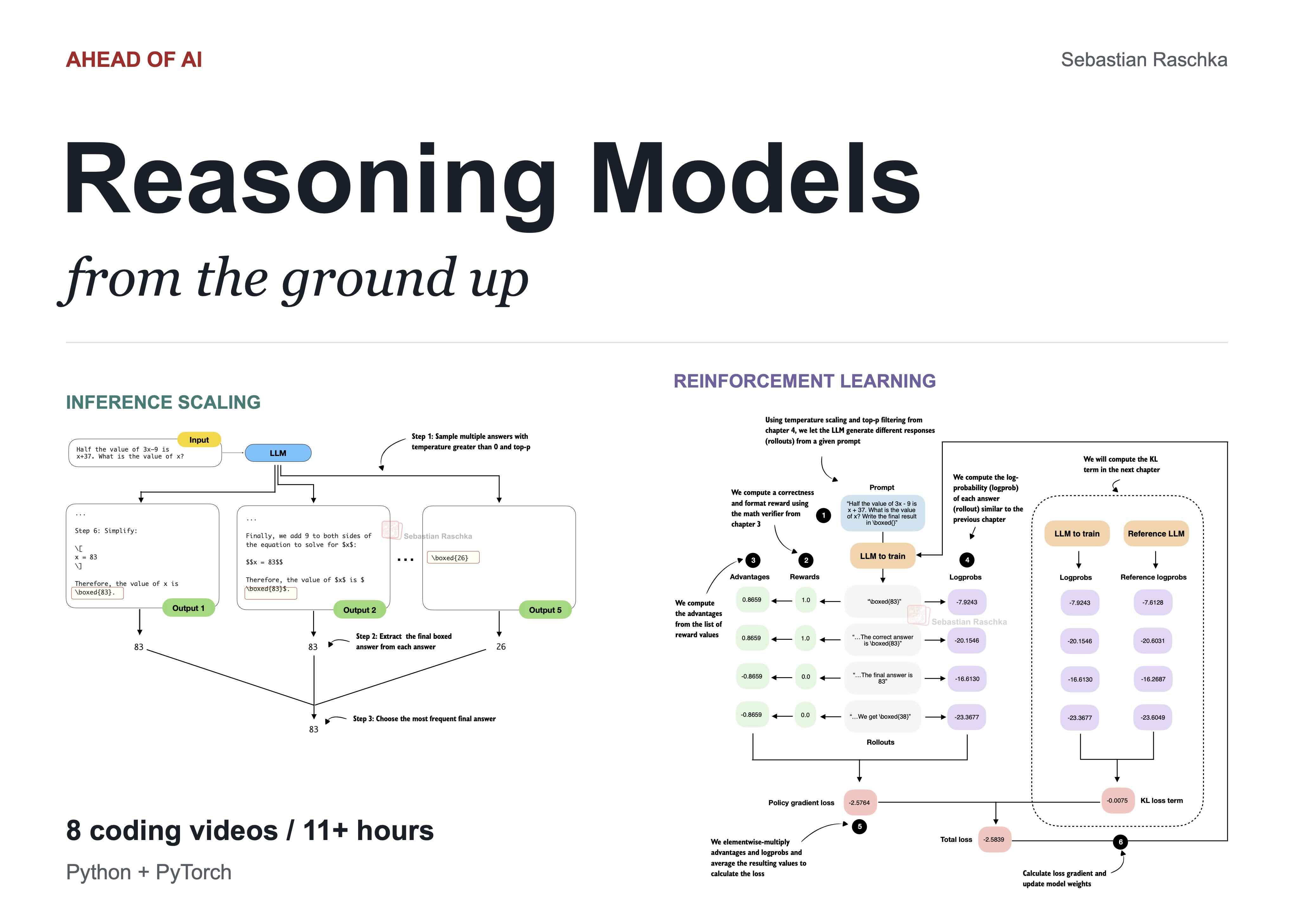
Sebastian Raschka has released an 11-hour video course demonstrating how to evaluate and improve reasoning models in Python using PyTorch, starting with a small pretrained model from the Qwen3 family. The introductory examples can run on a CPU; the author recommends a GPU for later training.
Sebastian Raschka has released Building Reasoning Models from the Ground Up, a course comprising eight instructional videos totaling 11 hours. Participants start with a small pretrained model from the Qwen3 family and implement methods for evaluating and improving it in Python using PyTorch. The course covers inference-time scaling, reinforcement learning and distillation.
The author recommends a good working knowledge of Python and PyTorch; taking the previous course is not a prerequisite. The initial text generation and evaluation examples can run on a CPU. For later experiments, especially training, a GPU is considerably more practical, according to the author. The first video covers installing dependencies with uv, choosing hardware and common environment setup issues.
Why it matters
The course provides a concrete procedure for implementing and exploring methods for evaluating and improving reasoning models using a pretrained model. Learners can start with examples on a CPU and address the need for a GPU when they reach more demanding experiments.
Relevant practical impact
What this means
For individuals
If you are familiar with Python and PyTorch, you can study the materials independently without taking the previous course.
Check the original
Event sources
only one source so far · 1 publisher, 0 independent. We count feeds from the same owner only once.