

Liquid AI releases open-weight LFM2.5-1.2B models for on-device AI
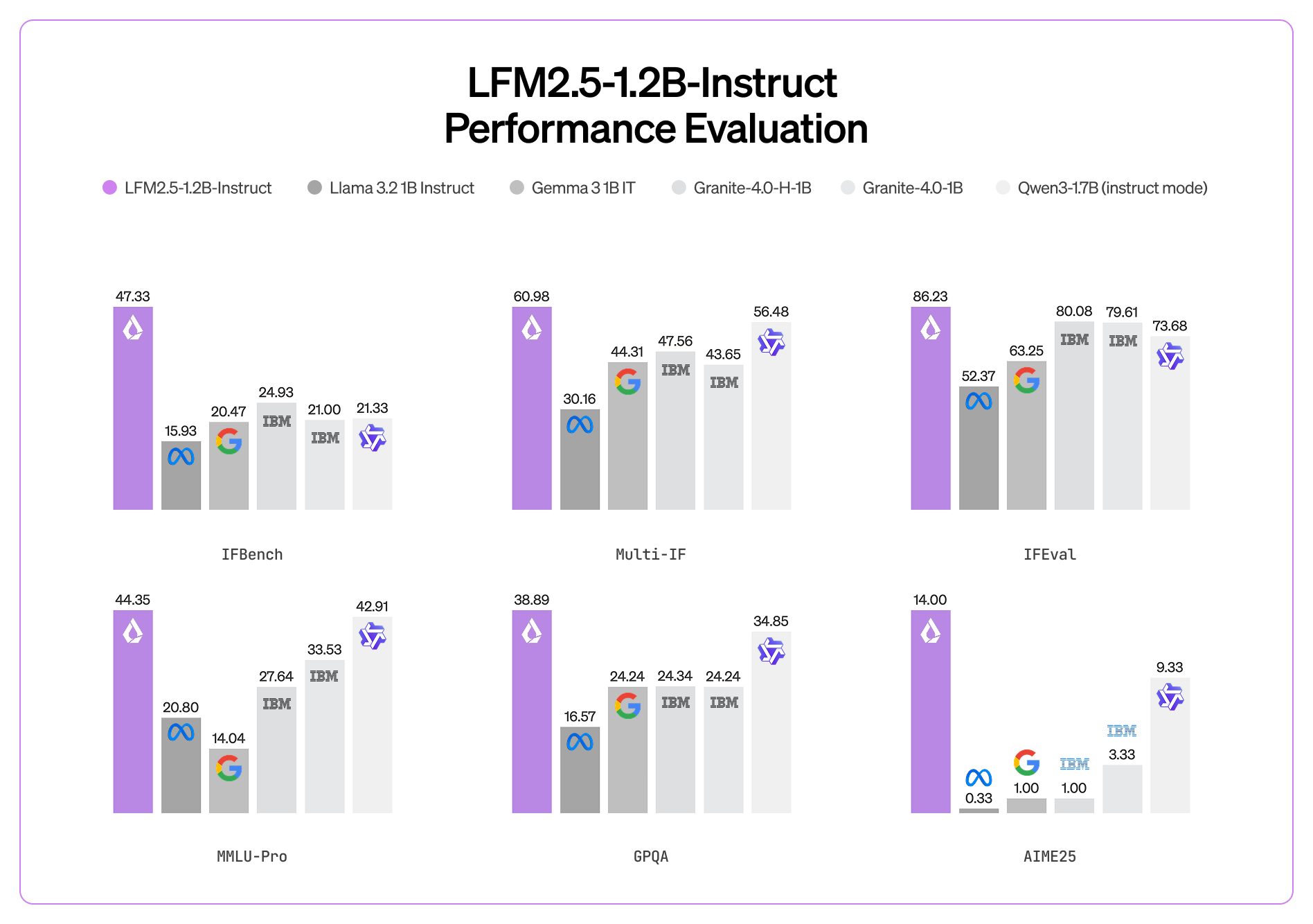
Liquid AI has released the open-weight LFM2.5-1.2B family of models for on-device AI, with pretraining on 28 trillion tokens. It includes Base, Instruct, Japanese, vision-language, and audio-language variants; according to the company, it outperforms Llama 3.2 1B, Gemma 3 1B, and Qwen3-1.7B on benchmarks.
Liquid AI has released the LFM2.5-1.2B family of models, designed for deployment on edge devices. According to the company, pretraining was expanded from 10 trillion to 28 trillion tokens, and post-training was expanded with more extensive reinforcement learning. The release includes six variants: Base and Instruct for general language tasks, a specialized Japanese model LFM2.5-1.2B-JP, a vision-language model LFM2.5-VL-1.6B, and an audio-language model LFM2.5-Audio-1.5B. All models are open-weight and available on Hugging Face and the LEAP platform; partners AMD and Nexa AI are collaborating on NPU optimization.
According to benchmarks published by Liquid AI, LFM2.5-1.2B-Instruct outperforms Llama 3.2 1B Instruct, Gemma 3 1B IT, Granite-4.0-1b, and Qwen3-1.7B on the GPQA, MMLU-Pro, IFEval, IFBench, Multi-IF, AIME25, and BFCLv3 tests. The Japanese variant LFM2.5-1.2B-JP achieves, according to the same tests, better results on Japanese benchmarks (JMMLU, M-IFEval, GSM8K) than the compared models, including the specialized TinySwallow-1.5B-Instruct.
The vision-language model LFM2.5-VL-1.6B, according to the company, brings improvements in processing multiple images at once and in multilingual image understanding (Arabic, Chinese, French, German, Japanese, Korean, Spanish). The audio-language model LFM2.5-Audio-1.5B processes speech and text natively without intermediate transcription and synthesis steps and uses a new detokenizer which, according to the company, is 8× faster than the previous Mimi solution used in the LFM2 model; it also supports CPU inference via a GGUF format compatible with llama.cpp.
The source text was only partially available; the description of the rest of the audio model is missing. See the source article for details.
Why it matters
Small open-weight models with low memory requirements make it possible to deploy AI assistants directly on mobile phones, in vehicles, or on IoT devices without the need for a cloud connection, which reduces inference costs and addresses data privacy concerns. For developers of edge applications, the combination of CPU speed, multilingual support, and specialized voice and image variants is particularly relevant.
Two audiences, two different impacts
What this means
For individuals
Developers and local AI enthusiasts have access to another open-weight model that runs on weaker hardware (phones, IoT, vehicles), including a voice and image variant, which can be tried without cloud infrastructure.
For a business
Companies building products on edge AI (local copilots, in-car assistants, IoT) gain an open-weight model with low memory requirements and fast inference on CPU, which according to Liquid AI outperforms competing models of similar size – which could reduce cloud inference costs and enable offline operation.
DevelopmentCheck the original
Event sources
clearly official source · 1 publisher, 0 independent. We count feeds from the same owner only once.