Skip to content

A practical perspective for individuals

Less monitoring. More value.

We turn new tools and features into one question: what can you do with them today, without unnecessary hype?

  • AvailabilityIs it actually out?
  • BenefitWhat work could this improve?
  • First stepWhat is worth verifying?
459 practical events in the selection 72 active sources Updated

Practical radar

What deserves your attention

Browse the archive →
context Coding

Simon Willison: programming experience retains its value even after the arrival of AI coding agents

In his commentary on the “Feeling sad about AI” discussion, Simon Willison describes how the initial disappointment programmers feel at the speed of AI agents usually fades once they realize that plenty of other work remains where their experience can be put to use.

What you get out of it

According to the author, experienced programmers retain their value even in the age of AI agents because they can use these tools more effectively than beginners and focus on problems beyond simply writing code.

1 source
Details and sources →
context Business and investment

Apple, through new CEO John Ternus, confirms an AI strategy built around iPhone and on-device data processing

The new CEO of Apple, John Ternus, called iPhone the best AI device at the Surprise and Shine event and emphasized that Apple Intelligence prioritizes running on-device to protect user privacy.

What you get out of it

Apple states that Apple Intelligence runs on-device whenever possible, so iPhone users should have greater control over their personal data than with solutions that send it elsewhere for processing.

1 source
Details and sources →
context Tools and apps

An AI battle on both sides of hiring: applicants and recruiters are making things worse for each other, according to Greenhouse

Applicants pay tools such as Jobscan for AI optimization of their CVs for ATS filters, while recruiters deploy their own AI screening in ATS because of the flood of similar applications — according to the CEO of Greenhouse, this is a “doom loop” in which AI on both sides makes the problem worse.

What you get out of it

Job applicants who pay to optimize their CVs with tools such as Jobscan rely on the assumption that an AI filter evaluates their application — but according to the source, that assumption does not hold universally, so investing in these tools may not have the desired effect, and the paid service also has no incentive to get applicants off the job market quickly.

1 source
Details and sources →
context New models

The Google Research team introduced the experimental DiffusionGemma model based on discrete diffusion

DiffusionGemma, a model created by fine-tuning Gemma 4, generates text through discrete diffusion in parallel blocks of 256 tokens and, according to the authors, achieves about 1 500 tokens per second on a single NVIDIA H100 GPU.

What you get out of it

Developers and researchers experimenting with open models gain evidence that diffusion decoding can offer significantly faster text generation than conventional autoregressive models through fine-tuning an existing model, rather than training from scratch.

1 source
Details and sources →
context Business and investment

AI remediation: a new category of work to check and correct AI outputs

According to an analysis by The Conversation, a new category of work is emerging called AI remediation – people checking and correcting erroneous outputs from language models. White-collar workers in finance, tech and retail report that this is actually adding to their workload.

What you get out of it

Anyone using AI tools in their work must reckon with the fact that verifying and correcting outputs can take up a substantial part of the time saved, rather than counting on an automatic time saving.

1 source
Details and sources →
context Productivity

Matt Webb: ChatGPT as a tutor helped him learn quaternions for the AR mode in the app Galactic Compass 2

Developer Matt Webb described how ChatGPT, acting as an interactive tutor, helped him understand quaternions for the AR mode in the app Galactic Compass 2 - something he had been unable to achieve through books or consultations with mathematicians.

What you get out of it

It shows a concrete way to use a chatbot as a patient tutor to understand difficult mathematics (quaternions), rather than as a generator of ready-made code - and that this understanding then allows you to write the code yourself.

1 source
Details and sources →
OpenAI context Productivity

Analysis: ChatGPT and Gemini tools may help with languages, but achieving fluency on their own is not proven

Research suggests that the ChatGPT and Gemini tools help practice speaking and writing. However, evidence that they alone are sufficient to achieve fluency is lacking. A review of 51 studies points to errors in feedback as well as excessive reliance on AI.

What you get out of it

For independent study, the tools can be used to repeat conversations and revise one's own texts. Suggested corrections need to be evaluated, and contact with people should also be maintained; using AI by itself has no proven sufficiency for achieving fluency.

1 source
Details and sources →
Google context update AI agents

Google expanded the agent CC to include specific household management tasks

Google updated the experimental agent CC (formerly Daily Brief) — it now handles specific household tasks such as signing permission slips, shopping lists and meal plans, runs on the Antigravity framework with Gemini models and supports up to 6 family members in the USA.

New: CC now specifies concrete household management tasks (signing permission slips, shopping lists, weekly menus); Runs on the Antigravity framework from Google (new technical detail); Works through a chat interface (new communication channel); Evolved from Daily Brief, which was introduced in the Gemini app in May as an iteration of the original Gmail/Calendar/Drive agent; Motivated by user feedback calling for household management, not primarily by productivity

What you get out of it

It shows the direction of development for consumer AI agents for the home — but for now, only for users in the USA over 18 with a personal Gmail account, so it is not an immediately usable tool for readers outside the USA.

✓ 2
Details and sources →
Anthropic context update Tools and apps

The outage affecting Claude API, Claude Code and Claude Cowork lasted 24 minutes; the incident is closed

Anthropic closed the incident of 14 August 2026: Claude API, Claude Code and Claude Cowork were unavailable for 24 minutes (20:14–20:38 UTC). The cause had been identified and the fix completed by 20:44 UTC, with full recovery confirmed at 21:58 UTC.

New: The outage lasted exactly 24 minutes from 20:14 to 20:38 UTC; The cause was identified at 20:30 UTC (16 minutes after the start); The fix was deployed at 20:44 UTC (6 minutes after identification); The incident occurred on 14 August 2026; Full service recovery was confirmed at 21:58 UTC

What you get out of it

If you were using Claude API, Claude Code or Claude Cowork on 14 August 2026 between 20:14 and 20:38 UTC, you may have encountered errors or outages; the services are now fully operational again.

✓ official
Details and sources →
Google context Tools and apps

Google is rolling out Gemini in Google Docs and Gmail, and disabling it is complicated for some users

Since April, Google has been gradually rolling out the Gemini bar in Google Docs to selected users. For personal accounts, it can be disabled through Smart features in Gmail (which also disables proofreading and smart compose); for business Workspace accounts, only the administrator decides. The Bye Bye Gemini extension for Chrome is an alternative.

What you get out of it

Users of personal Google accounts (@gmail.com) who see the Gemini bar in Google Docs and do not want it can turn it off, but completely removing AI features from Docs requires disabling Smart features in Gmail, which also disables proofreading, smart compose, smart reply and spellcheck.

1 source
Details and sources →
context Other

A creator on TikTok described typical signs of AI-written scripts for social media

On TikTok, creator @therealcornpop described recognizable signs of AI-written scripts for social media – hackneyed phrases, choppy punctuation, and above all, the lack of an opinion of the author’s own. Simon Willison quoted the commentary on his blog.

What you get out of it

Anyone writing scripts for TikTok or YouTube with AI assistance gets a specific list of warning signs that audiences use to recognize machine-written text and can remove them before publishing.

1 source
Details and sources →
context Coding

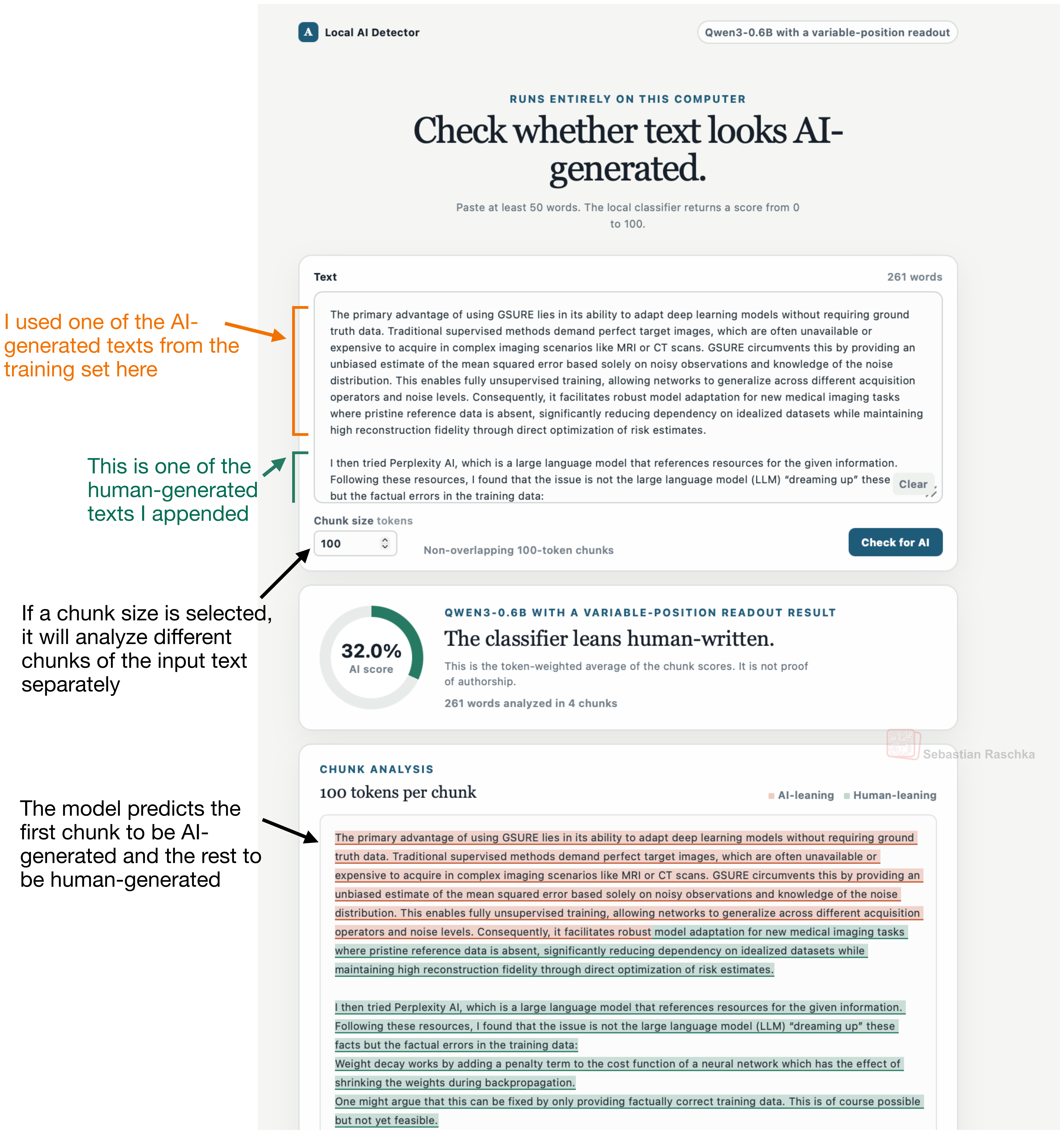
Sebastian Raschka published a tutorial on building an AI text detector from scratch

On the Ahead of AI blog, Sebastian Raschka described how to build an AI text detector from scratch using a fine-tuned DistilBERT model. The educational project also trains a small language model to bypass detection and highlights the risk of false positives.

What you get out of it

Anyone who writes text and uses tools such as ChatGPT to edit it risks having the resulting excessively edited text classified as AI-generated and flagged as spam, despite having written it themselves.

1 source
Details and sources →

When personal experience proves useful

Does it make sense for a team too?

Look at the same topics through the lens of processes, risks, and implementation within a company.

Go to the company radar →