

Robust AI deploys the collaborative robot Carter in warehouses and factories
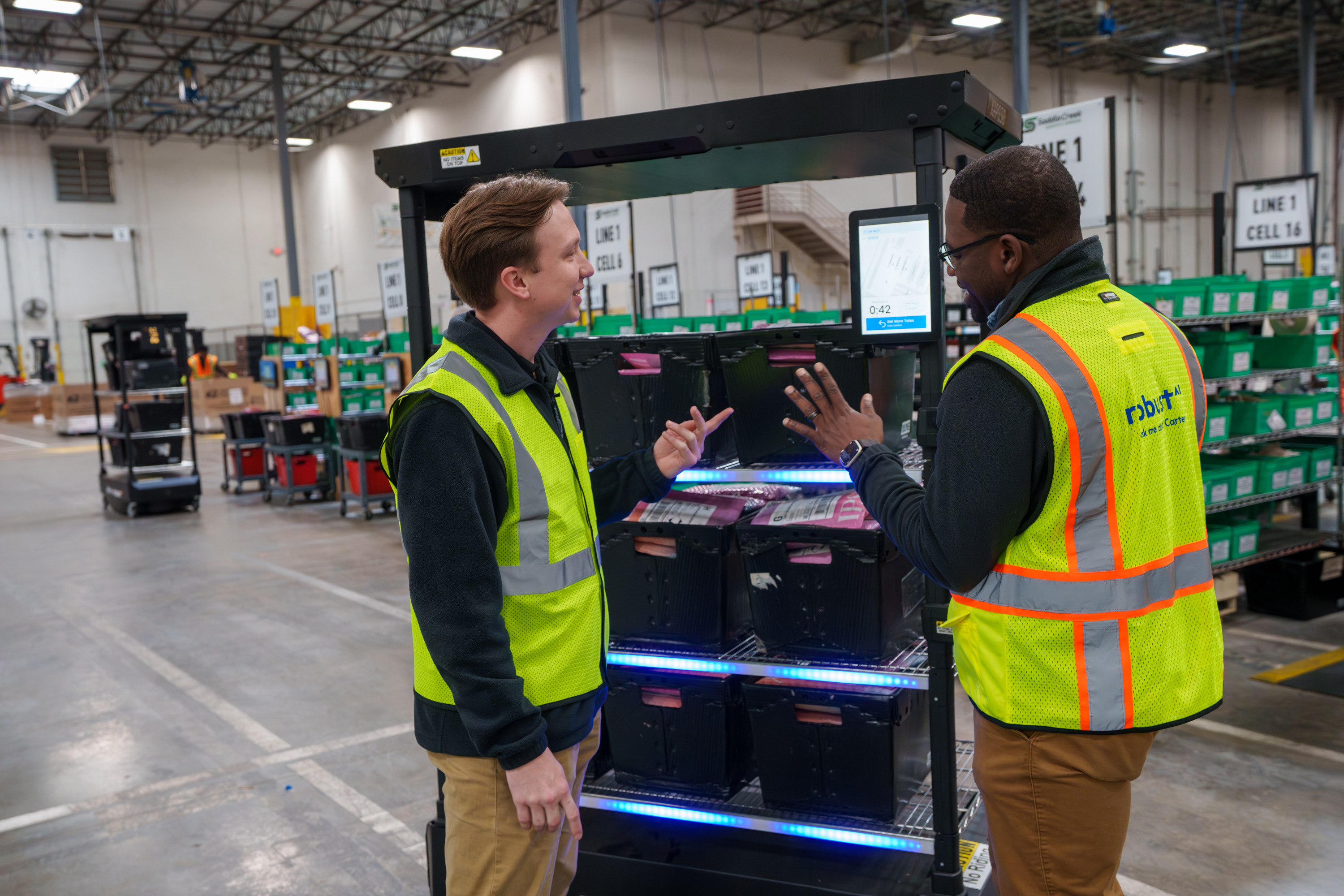
Robust AI, founded by Rodney Brooks and Anthony Jules, presents the mobile robot Carter with an AI vision system for collaborating with people in logistics warehouses and manufacturing operations. The robots are already deployed at customers.
Robust AI presents the mobile robot Carter, which the company says is designed to function as an assistant to human work in warehouses and factories, not as a replacement for it. Carter resembles a wheeled cart, featuring force-sensitive handles that allow easy one-handed guidance, an AI vision system, and holonomic wheels for movement in any direction. According to the company, workers can stop it, move it, or give it instructions via gesture or touchscreen while it is running.
The robots are currently deployed at customers' logistics warehouses and production lines, where they help people with picking and restocking goods and with moving materials around the facility. According to the company, workers in these environments walk an average of 30000 steps a day, and Carter is meant to reduce this burden by taking over the longer-distance movement of goods. The company offers several working scenarios: the robot can guide a worker to a pickup location, follow them to a loading zone, or independently move loads between stations.
Robust AI was founded in 2019 by Rodney Brooks (former director of CSAIL at MIT, co-founder of iRobot and Rethink Robotics) and Anthony Jules. According to Jules, the company deliberately focused on small and medium-sized operations that lack the resources for full automation costing 50 to 200 million dollars and often don't even have a conveyor belt, so the robot can be introduced into operations gradually, as needed.
The source also cites a peer-reviewed study from a hospital setting, where robots used for moving equipment interfered with nurses' primary tasks and were consequently taken out of service. Robust AI builds its approach on this example, aiming for the robot to supplement human work rather than get in its way.
Why it matters
For companies in logistics and manufacturing, this represents an alternative to costly full automation, as the robot is introduced gradually and without the need to rebuild operations. For facilities without conveyor belts or other heavy infrastructure, this lowers the entry barrier to partial automation of manual work. The sources do not state the price, the specific number of robots deployed, or the technical parameters needed to assess return on investment.
Relevant practical impact
What this means
For a business
Companies in logistics and manufacturing gain the ability to deploy a collaborative robot for moving goods without investing in full automation or rebuilding their operations, since the absence of conveyor belts is not an obstacle.
ProcessesCheck the original
Event sources
only one source so far · 1 publisher, 1 independent. We count feeds from the same owner only once.