

Pony.ai plans to deploy 100 000 autonomous light vehicles by 2030
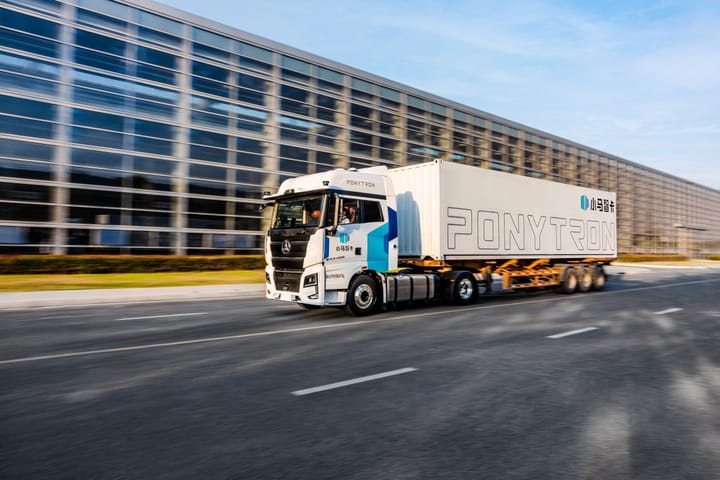
Chinese company Pony.ai has announced a plan to deploy up to 100 000 autonomous light vehicles (level L4) for urban logistics by 2030. For heavy trucks, it envisages 500–1000 vehicles within two to three years. According to the company, the cost of the autonomous driving kit (ADK) has fallen by 70 %.
Chinese company Pony.ai, based in Guangzhou, has unveiled an ambitious plan to expand autonomous freight transport. By 2030, it aims to deploy 100 000 autonomous light vehicles that would operate in urban environments between retail stores, distribution centers and refrigerated warehouses. For heavy trucks intended for long-distance transport in ports, on highways and for bulk transport in western China, the company plans to deploy 500 to 1000 vehicles over the next two to three years. According to the company, it had roughly 200 vehicles available as of November last year.
The vehicles are to use the in-house autonomous driving platform at level L4 under the SAE standard, meaning fully unmanned driving in defined scenarios. According to the company, the technologies for robotaxis and light trucks share the same technological foundation, with roughly 90% synergy, because both categories operate in similar urban environments. Heavy trucks require more vehicle modifications, but the decision-making logic is the same, according to the company. Data from all three applications (robotaxis, light and heavy vehicles) feed into a shared development cycle evaluated by the in-house world model PonyWorld 2.0.
According to Vice President He Xing, the expansion was made possible primarily by falling hardware costs – the price of the autonomous driving kit (ADK) fell by roughly 70 % for the latest generation of heavy trucks, which he said was reflected in both heavy and light vehicles. The company says this is why it had deliberately held off on mass production earlier.
Pony.ai works with manufacturer Sany Truck on heavy autonomous trucks and with CATL on light vehicles. In the future, it envisages an “autonomous driving as a service” model in which vehicle manufacturers would supply vehicles, logistics companies would own and operate fleets, and Pony.ai would provide the Virtual Driver technology and related services. Expansion is currently focused on China, but the company says it also sees potential in overseas markets.
Why it matters
The plan shows that Pony.ai views the falling price of the autonomous driving kit as a tipping point that enables mass deployment of autonomous trucks in place of the pilot fleets numbering in the hundreds used so far. The “autonomous driving as a service” model, in which vehicle manufacturers and logistics companies handle production and operation while Pony.ai supplies only the driving technology, suggests a possible direction for the commercialization of autonomous freight transport in China and potentially beyond.
Relevant practical impact
What this means
For a business
Pony.ai offers an “autonomous driving as a service” model in which vehicle manufacturers (Sany Truck, CATL) supply vehicles, logistics companies own and operate fleets, and Pony.ai provides only the Virtual Driver technology – a potential future alternative to maintaining their own fleets with drivers for companies in logistics and transport, but currently limited to the Chinese market.
StrategyCheck the original
Event sources
only one source so far · 1 publisher, 1 independent. We count feeds from the same owner only once.