

Meta deploys closed-loop liquid cooling in AI data centers
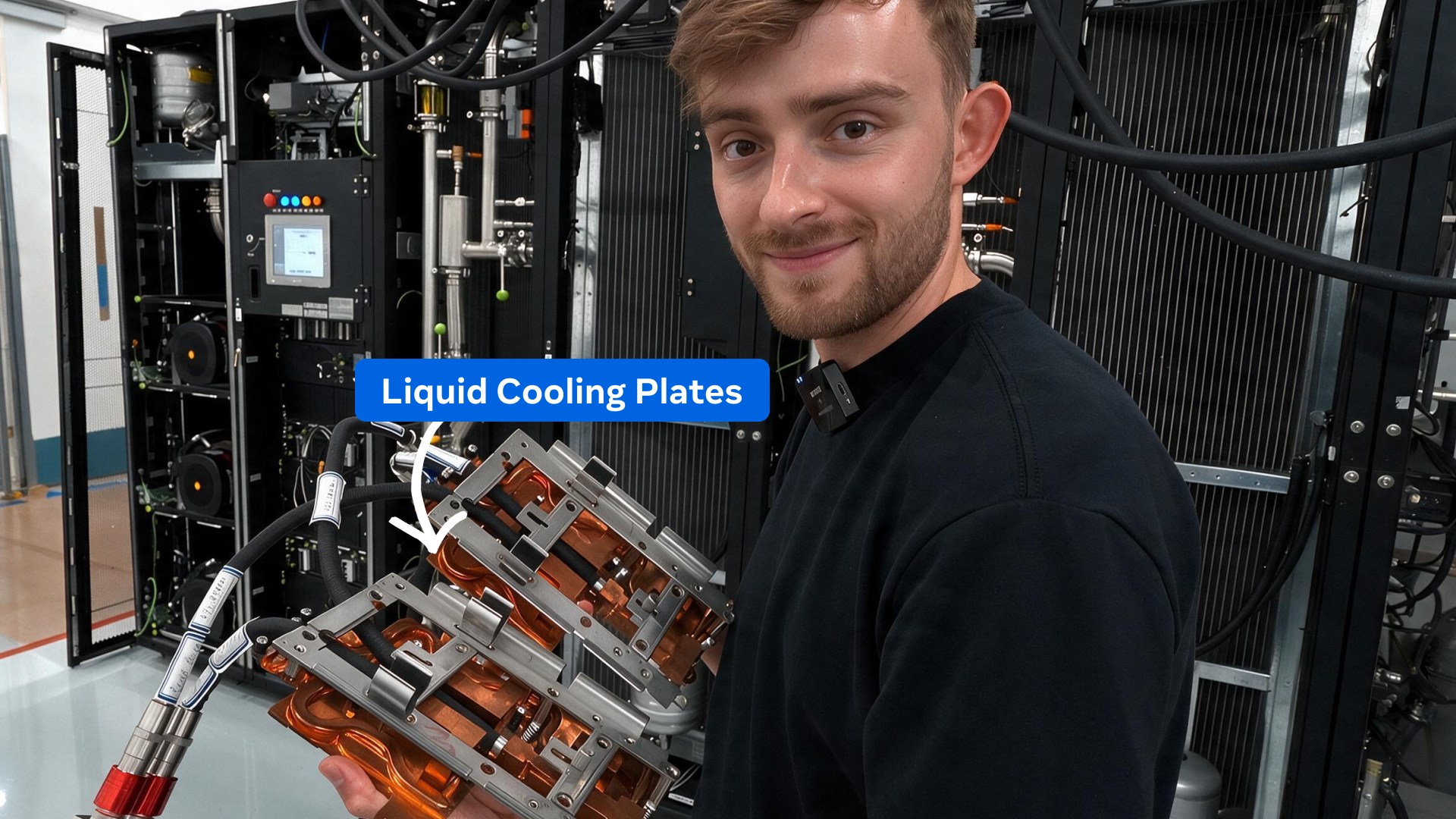
Meta uses closed-loop liquid cooling for GPU servers in new AI data centers, recirculating a mixture of water and glycol in a closed loop. According to the company, it is more efficient than air cooling in terms of both space and water, and the coolant lasts up to ten years.
Meta uses closed-loop liquid cooling for GPU servers in its latest AI-optimized data centers. The liquid (a mixture of water and glycol) passes through the hardware, carries heat into the server room, and then travels through a series of heat exchangers, where it cools down before returning to circulate through the servers. According to the company, the same coolant is thus used repeatedly in a closed loop without escaping from the facility.
According to Meta, this system is more efficient than air cooling in terms of both resource consumption and space requirements — air cooling with the same capacity would, according to the company, require a server tray almost twice as large, while liquid cooling allows more GPUs to fit into a rack of the same size, reducing the total number of racks needed. According to the company, a typical AI data center with a closed loop and dry coolers has lower annual water consumption than a few ordinary restaurants, and the company expects the coolant to last up to ten years without replacement. For facilities without built-in liquid cooling infrastructure, the company deploys Air-Assisted Liquid Cooling — racks with their own pumps and heat exchangers that function as a smaller, distributed version of the central system.
The shift to liquid cooling is linked to the increasing energy consumption and heat output of newer AI hardware; according to the article, older generations, such as rows of 16 Nvidia H100 chips, could still be air-cooled with minimal water consumption. Meta also shares its cooling designs externally through Open Compute Project — in 2025, it made the IcePack platform for liquid-cooled networking racks publicly available free of charge. The company also stated that it uses reinforcement learning to optimize the operation of its cooling infrastructure, and that it has extended this approach to air-cooled data centers across its network.
Details can be found in the source article.
Why it matters
For data center operators and designers, the approach described shows that, according to Meta, closed-loop liquid cooling can reduce water consumption to an operating level comparable to that of an ordinary restaurant while allowing GPUs to be packed more densely into racks, reducing floor space requirements and the number of racks. Sharing designs (e.g. the IcePack platform) through Open Compute Project also gives other companies the opportunity to adopt these findings without conducting their own research and development.
Relevant practical impact
What this means
For a business
Companies operating or planning AI data centers can draw inspiration from the approach described by Meta (a closed loop, lower space requirements, designs shared through Open Compute Project) to reduce water consumption and make better use of rack space without having to develop their own solutions from scratch.
ProcessesCheck the original
Event sources
only one source so far · 1 publisher, 0 independent. We count feeds from the same owner only once.