

Liquid AI released its own audio codec LiquidCodec for on-device LFM3 models
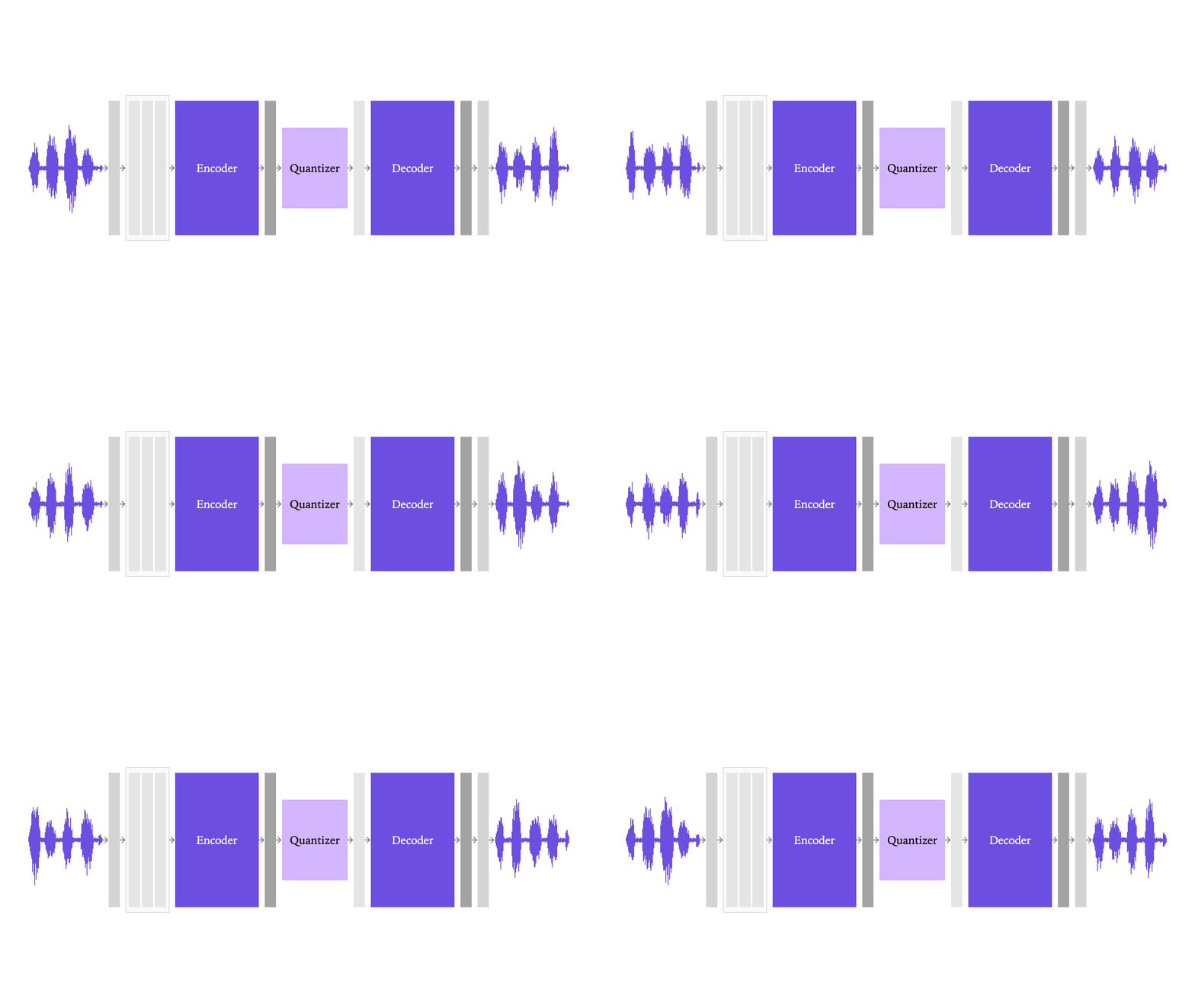
The company Liquid AI released the audio codec LiquidCodec (~74M parameters) as part of its on-device models LFM3-Audio-2B and LFM3-Omni-2B. It replaces the codec Mimi, using finite scalar quantization instead of residual vector quantization for faster audio encoding and decoding.
The company Liquid AI released its own audio codec LiquidCodec in late October 2026 as part of new multimodal models LFM3-Audio-2B and LFM3-Omni-2B intended for on-device audio processing. The codec has approximately 74 million parameters and serves as an audio tokenizer – it converts an audio recording into tokens that are predictable by a language model and subsequently back into audio.
LiquidCodec replaces the previously used codec Mimi, on which the earlier models LFM2-Audio-1.5B and LFM2.5-Audio-1.5B were built. According to Liquid AI, the main reason was a switch from the residual vector quantization (RVQ) method used by Mimi to finite scalar quantization (FSQ), specifically its extended variant grouped FSQ. This approach is intended, according to the company, to limit sequential dependencies between codebooks and enable parallel prediction of audio tokens.
LiquidCodec's architecture combines traditional spectral processing with a symmetric encoder and decoder built on blocks from the LFM3 architecture, with the encoder being fully causal. The company states that during development it focused on two priorities – the quality of audio tokens for easier prediction by the model, and the speed of encoding and decoding, which is meant to make the codec suitable for real-time, low-latency audio processing on edge devices. Remaining details about training and specific benchmark results are not available in the source – see the source article for details.
Why it matters
For developers of voice AI applications, this is another component to evaluate when building systems for speech processing directly on a device, where low latency and a small parameter count are key. The switch to the FSQ quantization method is meant, according to the company, to enable parallel prediction of audio tokens, which could simplify and speed up speech generation in products using the LFM3 models.
Two audiences, two different impacts
What this means
For individuals
Developers working with on-device voice models now have access to a new audio tokenizer which, according to the company, offers faster encoding and decoding than comparably sized alternatives, which is relevant when choosing a component for low-latency voice applications.
For a business
Companies developing voice AI products for edge devices gain another open-ish component to evaluate alongside existing solutions (e.g. Mimi), which may influence technology choices for future products with a voice interface.
Development More business impacts →Check the original
Event sources
clearly official source · 1 publisher, 0 independent. We count feeds from the same owner only once.