

Investors fund startup Embodied AI developing adaptive manufacturing robots
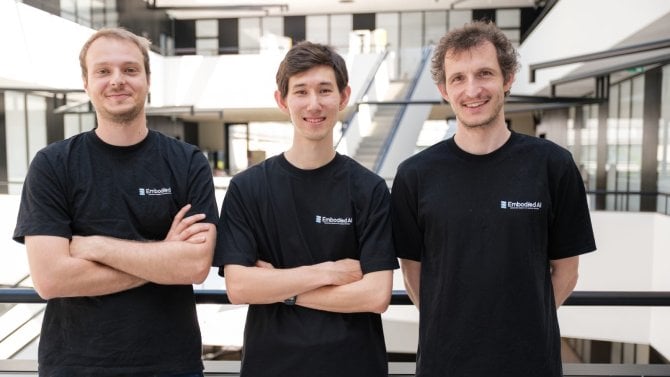
The Swiss startup Embodied AI has secured an investment round for robots that adaptively learn to work on the production line. The round was led by Faber VC, with participation from the Prague-based fund Look AI Ventures, the American Plug and Play San Francisco, and the Italian Techschop Capital.
The Swiss company Embodied AI has secured an investment round to develop robots that use machine learning to adaptively learn to work directly on the production line. The round was led by the Irish company Faber VC, with participation from the American fund Plug and Play San Francisco, the Italian Techschop Capital, and the Prague-based fund Look AI Ventures, which is leading the Czech portion of the investment.
Embodied AI's robots can handle tasks requiring fine motor control, such as cable handling or electronics assembly, and according to the company, they can operate safely alongside humans. The technology combines multiple small AI models designed for specific tasks that work together so the robot can handle variations within a given task. If it encounters an unfamiliar situation, a human operator can intervene remotely and correct its behavior, which generates data for further training of the models toward greater autonomy, without the need to halt production.
According to the source, the company is a partner of Google DeepMind and part of the Nvidia Inception program. Some of the largest European manufacturers are said to already be using the technology in electronics manufacturing, logistics, and automotive assembly. Embodied AI presents its automation as a way to keep the European manufacturing industry competitive at a time when large-scale production is shifting to other regions.
The sources do not state the size of the investment round or the specific date it closed.
Why it matters
For manufacturing companies, this is a signal that a commercially available alternative to rigidly programmed industrial robots is approaching – a system capable of learning and adapting to variable tasks without stopping the line. This may be especially relevant for industries with high assembly variability, such as electronics or the automotive industry, where automation of fixed operations has so far run up against limits.
Relevant practical impact
What this means
For a business
Investor interest in physical AI for flexible manufacturing is growing; companies in electronics, logistics, and automotive assembly may, over the coming years, gain an alternative to rigidly programmed robots that adapts to variable tasks without interrupting operations.
ProductivityCheck the original
Event sources
only one source so far · 1 publisher, 1 independent. We count feeds from the same owner only once.