

Google launches a pilot program for AI-generated interactive learning simulations
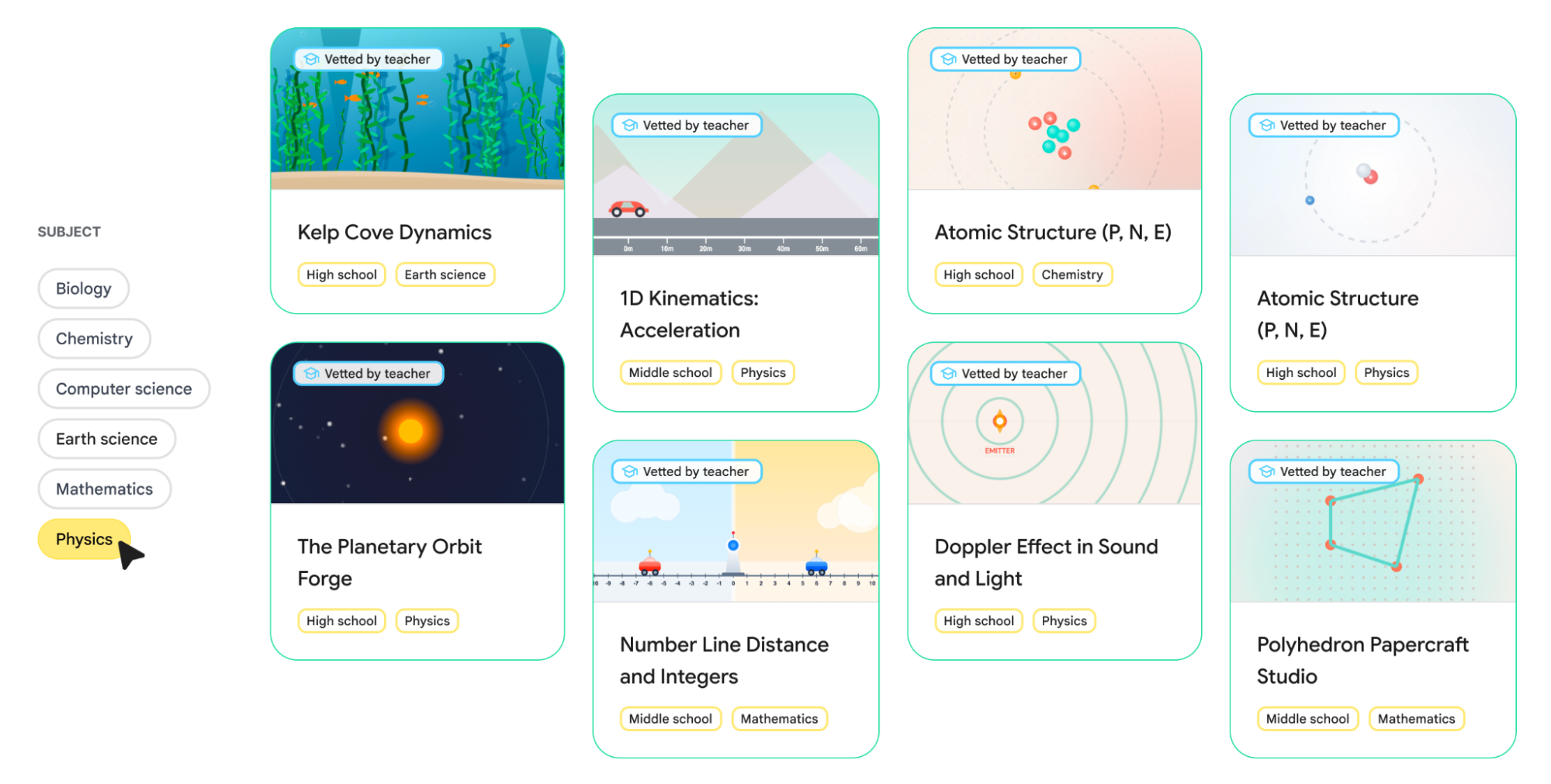
Google launched the Learning Interactives pilot program, which uses generative UI to enable teachers to create AI-generated interactive simulations for STEM subjects. The library contains over 30 materials, and schools using Google Workspace for Education have access.
Google introduced a research project called Learning Interactives that allows teachers to create AI-generated interactive learning simulations tailored to their own curriculum. The tool uses what is known as generative UI — an approach in which an AI model dynamically builds the user interface instead of it being programmed in advance — and, according to the company, is optimized for active learning and a deeper understanding of the subject matter rather than passive reading or watching videos.
The company also released a pilot library with more than 30 ready-made interactive materials in English for STEM subjects (physics, chemistry, biology, mathematics), aimed primarily at lower and upper secondary schools. According to the company, the materials were generated by AI and subsequently reviewed by teachers after the project received positive feedback from a group of educators testing it. The project builds on LearnLM, a family of models from Google tuned for education from 2024, and on the Learn Your Way research experiment from 2025, which focused on reworking a traditional textbook using generative AI.
According to the company, the content generation process includes self-correcting loops that iteratively check pedagogical quality (progressively increasing difficulty across levels, coverage of learning objectives), functionality (whether controls work, whether the task can be solved) and the visual aspects of the material. The checks also include agent-based evaluation processes in which AI opens an instance of the Chrome browser and tests the simulation as a user, including trying extreme setting values.
Schools using Google Workspace for Education have access to the pilot through the Google for Education Pilot Program, where they can provide feedback to improve the tool. The company describes the project as an early step toward broader public availability of similar interactive materials. The source text does not contain information about pricing, the exact date of broader availability or supported languages other than English. Details can be found in the source article.
Why it matters
For STEM teachers, this is a tool that could reduce the costs and time needed to create interactive teaching materials tailored to a specific curriculum — according to the company, creating such materials has so far been costly and time-consuming. For schools using Google Workspace for Education, it is currently a limited opportunity to participate in testing and help shape further development of the tool, not a widely available feature.
Two audiences, two different impacts
What this means
For individuals
Physics, chemistry, biology and mathematics teachers at lower and upper secondary schools are gaining the ability to create their own interactive simulations tailored to their curriculum without having to program the materials themselves.
For a business
For schools and educational institutions using Google Workspace for Education, this is an opportunity to test a tool that could reduce the costs teachers incur when creating interactive teaching materials, though for now only through a limited pilot program.
ProductivityCheck the original
Event sources
only one source so far · 1 publisher, 0 independent. We count feeds from the same owner only once.