

Company Delska opens the first AI data center in Latvia
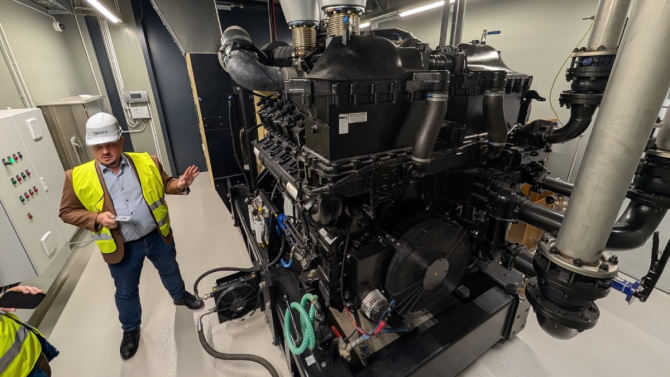
The company Delska has opened the first Latvian data center for AI in Riga: 10 MW (expandable to 30 MW), liquid cooling for racks up to 250 kW, TIER III certification, 100% renewable energy, and use of waste heat for district heating.
The Latvian company Delska has opened the country's first data center in Riga intended for AI operations. The facility was built as an extension to an older data center building, has an area of 7 100 square meters and a current capacity of 10 MW with the possibility of expansion to 30 MW. The space is designed for roughly a thousand racks, with individual cabinets able to handle a power input of up to 250 kW compared to the usual 5 to 15 kW, which allows the deployment of servers with accelerators such as Nvidia Blackwell or Vera Rubin.
The high power input requires direct-to-chip liquid cooling with CDU units separating the primary and rack cooling loops. For standard IT equipment, air cooling is used, and given Riga's cooler climate, indirect free cooling is often employed. According to Delska, the system is meant to achieve a PUE energy efficiency below 1.3 even at full load. Waste heat from the cooling loop is meant to be fed back into the district heating network for residential buildings.
The data center is TIER III certified by the Uptime Institute (two fully separate power branches) and powered exclusively by renewable energy. Backup power consists of Li-Ion or VRLA batteries and diesel generators in an N+1 or 2N configuration capable of taking over the entire 10MW load within 10-15 seconds; the generators use renewable HVO diesel from Neste, which according to the manufacturer has CO₂ emissions up to 90 percent lower than conventional diesel. The fuel tanks are sized for 24 to 48 hours of operation.
The facility is located along the Baltic Highway, a 100G optical link with a throughput of 9.6 Tb/s connecting Tallinn, Riga, Vilnius, Warsaw and Frankfurt. The project was personally opened by Latvia's then Prime Minister Evika Silina, and for the country it represents one of the strategic investments in modernizing the economy.
Why it matters
The project shows what a smaller but technically modern AI data center looks like in a European context, where there is no room for complexes spanning hundreds of MW as in the US. For companies seeking colocation or hosting for AI workloads in Europe, capacity is growing outside traditional hubs, with a connection to the backbone network to Central Europe and certified power reliability.
Relevant practical impact
What this means
For a business
Companies looking for European capacity for AI computing (colocation, GPU hosting) have gained a new option in the Baltics, featuring modern cooling for high-performance servers and a connection to the backbone fiber optic route to Central Europe.
StrategyCheck the original
Event sources
only one source so far · 1 publisher, 1 independent. We count feeds from the same owner only once.