

AI photo editors are moving from editing to reconstructing image content
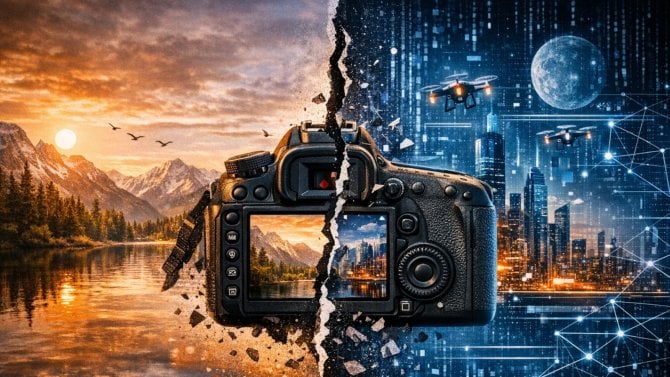
According to Root.cz, AI photo editors are ceasing to be passive tools and beginning to actively reconstruct image content – computing details and smoothing textures without metadata distinguishing this from the original capture.
According to an article on Root.cz, the role of artificial intelligence in photo editors is changing from a passive tool to an active co-creator of the image. While earlier post-production worked exclusively with data recorded by the sensor (adjustments to exposure, contrast and colors, noise reduction), current AI editors automatically suggest edits, reconstruct missing parts of the scene and smooth textures that the algorithm identifies as optical or sensor errors. According to the text, part of the resulting photograph therefore no longer comes from the original capture, but from retrospective computation.
The author distinguishes three types of intervention – retouching (removing distracting elements without changing what the image conveys), reconstruction (computing missing information from surrounding areas of the image) and generation (creating content that did not exist at the moment of exposure). According to the article, however, all three types are saved in a single resulting file (e.g. JPEG or HEIF), and neither the metadata nor the internal structure of the image usually indicates which type of intervention took place. According to the author, platforms then often group all these edits into a single “AI” category, although they differ fundamentally in both technical terms and meaning.
According to the article, the consequence is a distorted context rather than a distorted image itself – an image with a minor technical adjustment may be viewed as just as problematic as entirely generated content. The text is part of a longer series on AI in photography (previously described installments covered AI directly in the camera and AI in metadata and provenance credentials).
The rest of the article was not available in the accessible source. You can find details in the source article.
Why it matters
Photographers are losing track of when their editor is merely correcting technical flaws and when it is actually adding to the content of the scene, because, according to the article, neither the standard output file nor its metadata indicates this distinction. This has implications for the credibility of photography as evidence of reality, especially where it matters most – in journalism, documentation or legal contexts – because the same “AI” label can now cover both minor retouching and entirely generated content.
Two audiences, two different impacts
What this means
For individuals
Photographers should be aware that common AI features in editors (filling in details, smoothing textures) are no longer just technical corrections, but may actually compute or create part of an image without the resulting file or metadata clearly distinguishing it from the original capture.
For a business
Companies working with photographs (media, marketing, archives) face the risk that minor technical retouching and fully generated content will fall under the same “AI” label, which complicates transparent disclosure of image origins and may damage the credibility of published content.
Risks and complianceCheck the original
Event sources
only one source so far · 1 publisher, 1 independent. We count feeds from the same owner only once.