

Skild AI's S1 robotic model deployed at NVIDIA factory for Blackwell GPU assembly
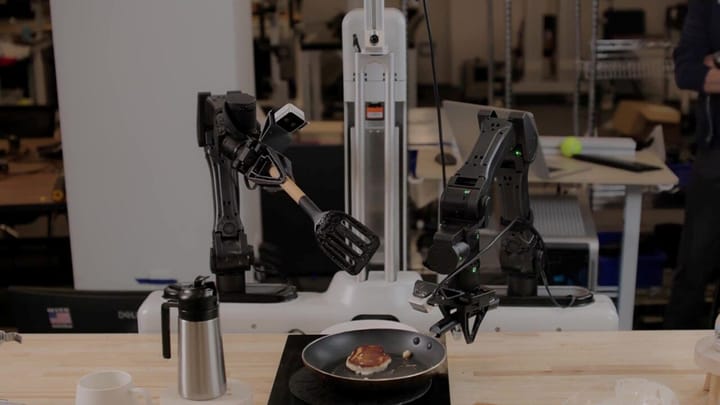
Skild AI has deployed the S1 model at NVIDIA's factory in Houston, where, together with partner Foxconn, it helps assemble systems with Blackwell GPUs, and has announced annual revenue of $100 million. The model was previously introduced as a system that learns new tasks from a single video.
The S1 robotic foundation model from Skild AI is being deployed at NVIDIA's factory in Houston, where, together with Foxconn, it powers dual robotic arms in the assembly of systems with Blackwell GPUs. According to Skild AI, the company has reached annual recurring revenue (ARR) of $100 million, ten months after the model's first commercial deployment.
The S1 model, developed by Pittsburgh-based Skild AI, is designed to learn previously unseen, multi-step tasks from a single video demonstration. According to the company, it is built on NVIDIA's infrastructure — the Cosmos, Isaac Lab, Isaac Sim, and Omniverse technologies — used for data generation, training, simulation, and deployment. The model can adapt to object displacement, recover from errors, and combine learned skills into sequences for which it was not explicitly programmed. According to Skild AI, in one experiment only 11 minutes elapsed between recording a demonstration of planting a plant and the robot performing the task autonomously.
According to Amit Goel, director of product management for autonomous machines at NVIDIA, the deployment of the S1 model in Blackwell system assembly demonstrates the value of adaptable robotic intelligence in a specific manufacturing application. Goel also stated that data collection on real robots remains the main bottleneck — it is slow and expensive, because the robot must handle variability in objects, lighting, placement, and physical contact. According to him, simulation and synthetic data can speed up this data collection. According to Goel, NVIDIA expects the industry to move toward shared foundation models usable across different types of robots, including robotic arms, four-legged robots, and humanoids.
Why it matters
For manufacturing companies, this shows a concrete example of a robot deployment that is retrained for new tasks from a video demonstration instead of manual reprogramming — according to the company, this shortens the time needed to adapt automation when products or processes change. The announced annual revenue of $100 million also serves as a market signal for companies considering purchasing similar robotic systems, showing that foundation models for robots are moving from lab demonstrations into real commercial operation.
Release card
S1
Skild AI
- Inputs
- The input is a single video demonstration of a task, the output is robotic actions (controlling dual robotic arms).
- Availability
- Deployed at NVIDIA's factory in Houston for assembling systems with Blackwell GPUs, in collaboration with Foxconn.
- Experiment se sázením rostliny (doba od ukázky po samostatné provedení) 11 minut This is the amount of time that elapsed between recording the video demonstration of the task and the robot performing it autonomously.
- Assembly of production systems with Blackwell GPUs in the factory
- Learning new multi-step tasks from a single video demonstration
- Adapting to object displacement and recovering from errors during manipulation
The card summarizes information from the article and any dated corrections, with a link to the original source. It is not our assessment of the model. It does not yet have a dedicated editorial profile. Model selection and other announcements →
What was added since the original report
Verified updates
-
The S1 model is deployed at the Nvidia factory in Houston; The application of the deployment is Blackwell GPU assembly; Skild reached $100 million in annual revenue in ten months; The deployment partner is Foxconn; The model uses a dual robotic arm
- The S1 model is deployed at the Nvidia factory in Houston
- The application of the deployment is Blackwell GPU assembly
- Skild reached $100 million in annual revenue in ten months
- The deployment partner is Foxconn
- The model uses a dual robotic arm
Two audiences, two different impacts
What this means
For individuals
For technicians and operators in manufacturing, this suggests a shift from reprogramming robots to retraining them by recording a video demonstration of the task.
For a business
The real-world deployment of the S1 model in a Blackwell GPU assembly factory, together with the announced annual revenue of $100 million, is a signal to manufacturing companies that robotic foundation models are moving from demonstrations to production and may shorten the time needed to retrain robots for new tasks.
ProductivityCheck the original
Event sources
independently confirmed · 2 publishers, 1 independent. We count feeds from the same owner only once.